
Chop Chop: Cooking the Food of Nigeria, written by Ozoz Sokoh, is a beautiful celebration of Nigerian cuisine with a collection of 100 regional recipes alongside history and photography. A few highlights include Meat Pies, Groundnut Chop (White Rice, Groundnut Stew, and Lots of Sides), Garden Egg Sauce, Chicken Pepper Soup, and Arosidosi (Rice Pudding). I will also be sharing her recipe for Kokoro (Crunchy Corn Sticks) following the review.
Disclosure: I received this book from Artisan Books in exchange for my honest review. All opinions and statements are my own.
Ozoz Sokoh
Ozoz Sokoh is a Nigerian food writer and educator. She started her food blog, Kitchen Butterfly, in 2009 to share her passion for food and notebooks of recipes with others.
Her work has been featured in Brittle Paper, Smithsonian Magazine, Gastro Obscura, CNN’s African Voices, Anthony Bourdain: Parts Unknown, and more. She has also spoken at TEDx and conferences hosted by the Culinary Institute of America.
This is Ozoz’s first cookbook.
Chop Chop: Cooking the Food of Nigeria

Ozoz begins Chop Chop with an introduction and memories of her childhood growing up in Warri, on the southern coast of Nigeria.
For those new to Nigerian cuisine, she has put together an incredible overview of the history that has shaped the ingredients and flavors, language notes, cooking techniques, markets, and the culture surrounding the food.
She has even included an illustrated map (by Chi Nwosu) of Nigeria with the country’s regions, states, cities, notable dishes, and descriptions of each area.
Chapters are divided according to the following: A Party in Your Mouth: Small Chops; When You Wake Up is Your Morning: Breakfast; Knee Chop: Salads; The Main, The Main: Rice and Beans; Assorted: Of Meat and More; All-Time favorites: Stews and Sauces; More Than Just Fufu: Chews and Swallows; Lunch and Dinner of Champions (Sometimes Breakfast, Too): Soups; Things to Keep the Mouth Moving: Snacks; Sweet Mouth: Candies and Desserts; Quench Your Thirst: Drinks; and Cuisine Basics.
The photography is provided by James Ransom. Many of the recipes are paired with a half to full-page vibrant photo of the finished dish. I especially love the labeled full layout of highlighted ingredients at the beginning of each chapter. There are also a few step-by-step photos of specific techniques such as wrapping bean pudding in banana leaves and forming swallows.
Measurements are listed in US Customary and Metric. Titles are written in the original language and/or English. Each recipe has a headnote with background information, ingredient notes, yield, helpful tips, and variations.
Kokoro (Crunchy Corn Sticks)
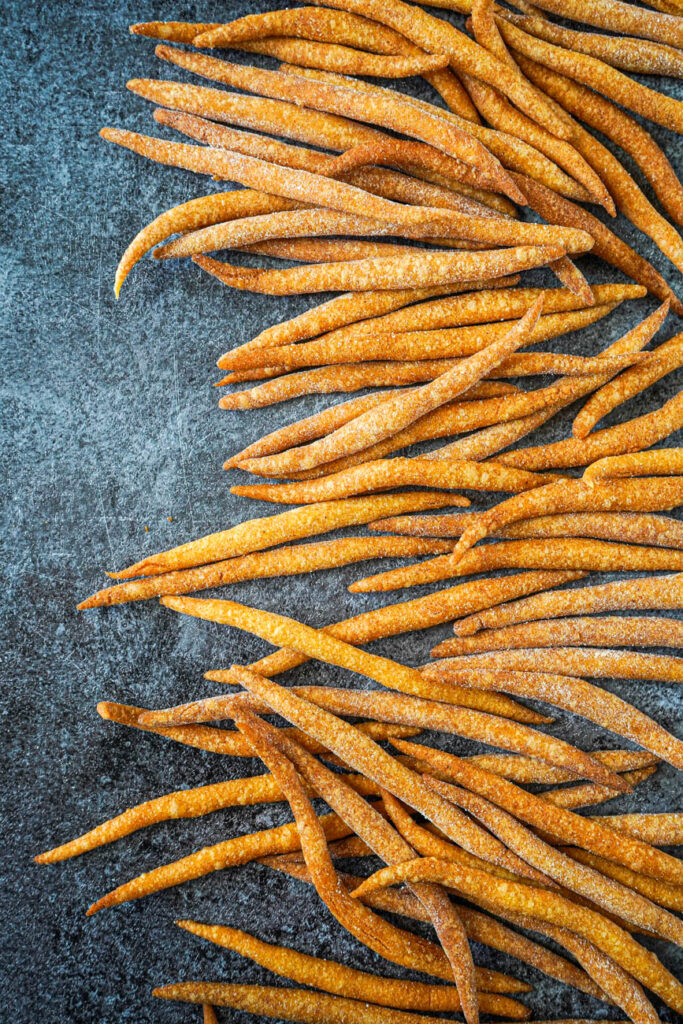
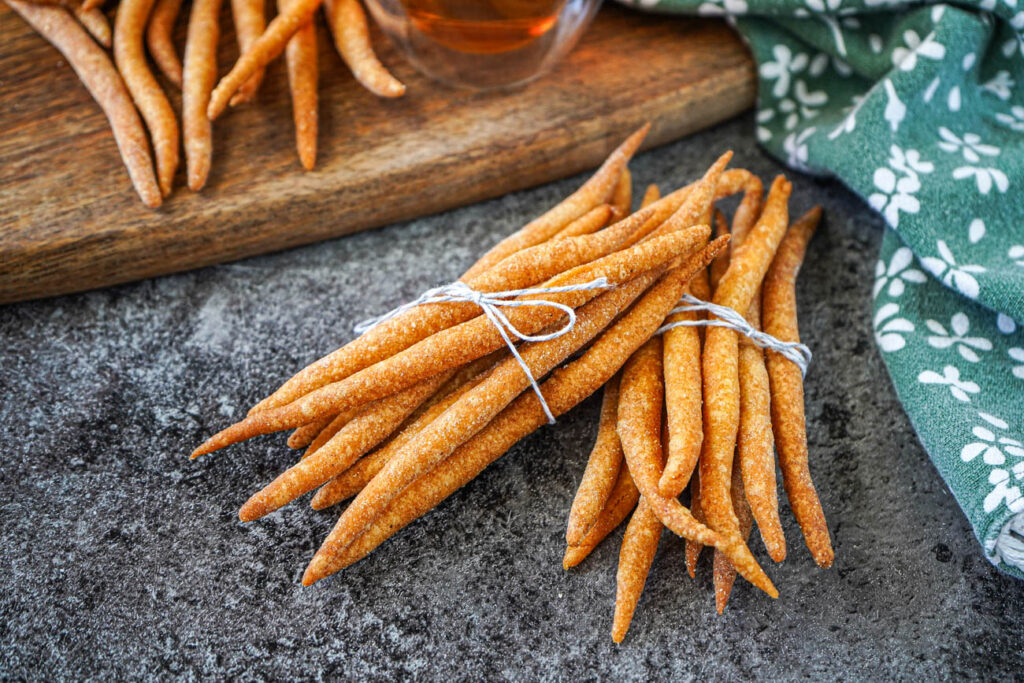
To pair with this review, I made Ozoz’s Kokoro (Crunchy Corn Sticks)! These Nigerian pencil-shaped, tapered sticks are formed with a spiced corn flour dough.
For this recipe, the sticks are about 1/3 inch (8.5 millimeters) thick and 4 inches (10 centimeters) long. When sold, they can vary from this length to roughly 24 inches (60 centimeters).
Ozoz states, “if you’re ever on Lagos Island and see an enamel tray of thin, long sticks, buy some, wrapped in newspaper.”
She also writes that their taste is reminiscent of crunchy, toasted corn tortilla chips. To get that extra crispy texture, the Kokoro are first fried, then need to rest for a few hours (to overnight) before baking briefly.
The wait is worth it for that beautifully crisp texture contrasting with the variety of seasonings- though I may have sneaked one (or 5) after the initial frying.
A Few Kokoro Tips

The dough can be made with either yellow or white corn flour. I went with yellow for the photos in this post. Do not use cornmeal. It is ground too coarse.
Sift the corn flour before mixing with the other ingredients. This will help prevent lumps.
Dry Pepper refers to single or multiple varieties of ground hot red peppers. I used ground cayenne.
Do not fill the pot more than halfway with the oil. It will bubble up a little immediately after adding a few of the Kokoro. Fry the sticks in batches, taking care to not overcrowd.
The recipe can easily be halved to make 50 sticks.
Other Dishes
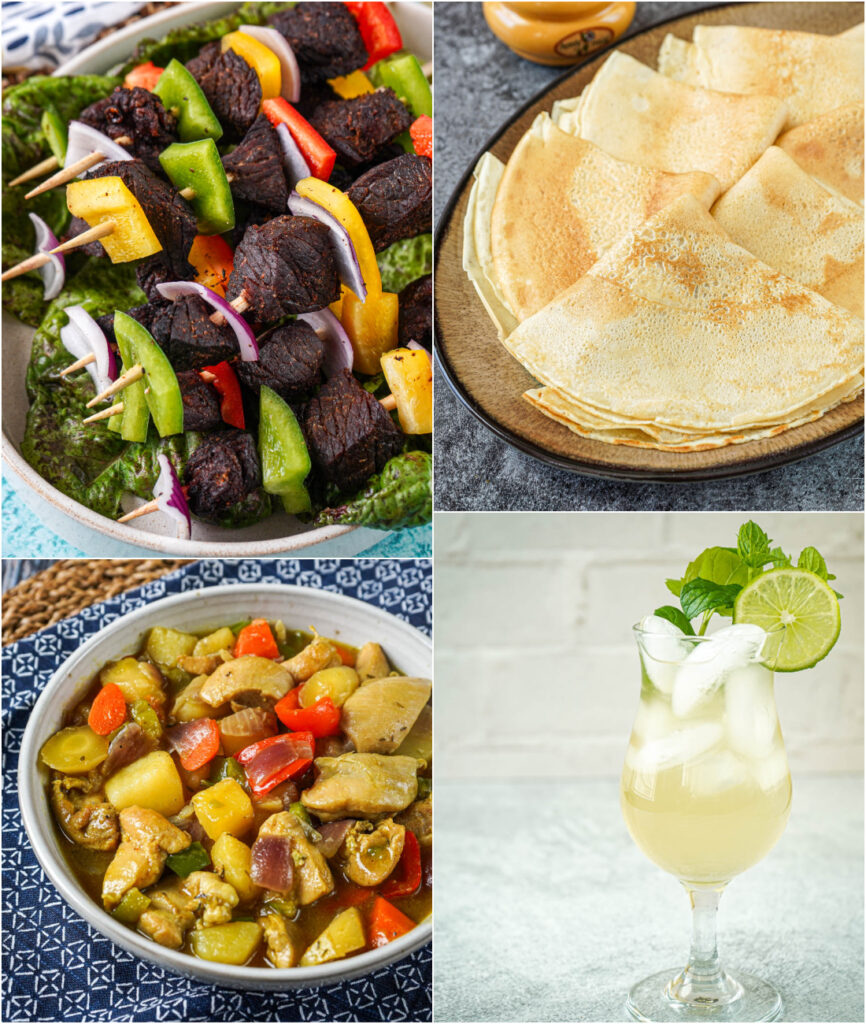
I also made Stick Meat, Nigerian Pancakes, Chicken Curry, and Pineapple Skin Drink.
The Stick Meat recipe can be found in the A Party in Your Mouth chapter. These fun little skewers are arranged with diced peppers and red onions between cubes of simmered, then fried spiced beef. The result is such a vibrant combination of colors and flavors.
My kids were especially excited to make the Nigerian Pancakes. Thinner than American-style pancakes and slightly thicker than crepes, the batter has a slight caramelized flavor and creaminess due to the addition of evaporated milk and vanilla. After blending everything together until smooth, ladles of the batter are swirled in a hot skillet and cooked until golden. They can be served with honey, pancake syrup, or jam. Ozoz has even added a savory option with dry pepper and vegetables.
The Chicken Curry was another family favorite. Pieces of chicken are briefly marinated, then simmered with potatoes, onions, bell peppers, and spices until tender. We paired the curry with rice, but it also goes well with spaghetti.
The same week I received this book, I happened to also be making something that required cubed pineapple. I was so excited to come across the recipe for Pineapple Skin Drink as a way to use up the pineapple skins and core! After cleaning the skins, they are simmered in a large pot of water with ginger, sugar, and spices. The resulting light and fruity drink can be served warm or over ice as I did.

Chop Chop is a fantastic pick for those interested in regional Nigerian cuisine along with a closer look at the ingredients, culture, and people behind the food. There is a varied assortment of vegetable, meat, and seafood-based options, some coming together in as little as 20 minutes and others requiring longer rest or simmering times.
Many of the ingredients are becoming more available in larger American grocery stores. Having a market with West African food will be helpful in locating items such as ijebu garri, dried àbàchà, red palm oil, Caribbean seasoning peppers, ground crayfish, lemongrass, ground mace, dried tiger nuts, and more. Substitutions are provided when possible and Ozoz has put together a list of sources to locate some items online.
Kokoro (Crunchy Corn Sticks) Recipe
Excerpted from Chop Chop by Ozoz Sokoh (Artisan Books). Copyright © 2025.

Kokoro (Crunchy Corn Sticks)
Ingredients
- 2 1/2 cups (375 grams) corn flour sifted, plus more as needed, divided
- 3 tablespoons sugar
- 1 teaspoon fine sea salt
- 1 teaspoon ground ginger
- 1/2 teaspoon onion powder
- 1/2 teaspoon dry pepper
- 1/2 teaspoon garlic powder
- 1/2 teaspoon ground cloves
- neutral oil for frying
Instructions
- In a medium bowl, whisk together 1 cup (125 grams) of the corn flour, the sugar, salt, ginger, onion powder, dry pepper, garlic powder, and cloves.
- In a small bowl, whisk together 1/4 cup (about 30 grams) of the corn flour mixture and 1/2 cup (120 milliliters) room-temperature water until smooth to form a slurry.
- Place 1 cup (240 milliliters) warm water in a medium pot over low heat. Make circular stirring motions with a wooden spoon, sturdy ladle, or whisk, then slowly drizzle the slurry into the center, stirring continuously as you go.
- Cook, stirring, for 1 to 2 minutes, then cover and cook until the mix gelatinizes and bubbles vigorously on top, 7 to 8 minutes.
- Gently remove the lid and give the mixture a thorough stir, then slowly add the remaining corn flour mixture, stirring continuously until it is fully incorporated.
- Cook, stirring vigorously, for 2 to 3 minutes in order to smooth out any lumps. Cover the pot, remove it from the heat, and set aside until the mixture has cooled, about 20 minutes.
- Sprinkle a rimmed baking sheet with 2 tablespoons of the corn flour to prevent sticking.
- Sprinkle 1 to 2 tablespoons corn flour on a clean counter and scoop the cooked corn flour mixture out of the pot onto the counter.
- About 1/2 cup (62.5 grams) at a time, knead the remaining 1 cup (125 grams) corn flour into the cooked dough.
- Divide the dough into two equal pieces and flatten one piece into a 5 by 10 inch (12.5 by 25 centimeter) rectangle.
- Cut a 1 inch (2.5 centimeter) grid to make 50 squares and set aside. Repeat with the other piece.
- Dust your work surface with more corn flour, if needed.
- Take a piece of the dough and roll it against the surface until pencil-thin. Classic Kokoro tapers at both ends, so each piece should be about 4 inches (10 centimeters) long and 1/3 inch (8.5 millimeters) wide at its thickest, with the ends rolled very thin. Place the rolled-out dough on the prepared baking sheet and repeat with the remaining dough.
- Line a rimmed baking sheet with a wire rack or paper towels.
- Fill a wok or large Dutch oven with about 2 inches (5 centimeters) of oil; it should come no more than halfway up the vessel. Heat the oil over medium-high heat to 350˚F (175˚C).
- Working in batches, add the Kokoro to the hot oil, being careful not to overcrowd the pan. Fry, frequently moving the pieces around with a slotted spoon to cook evenly on all sides, until golden brown, about 4 minutes total.
- Use a slotted spoon to transfer the Kokoro to the prepared baking sheet. Repeat with the remaining Kokoro, allowing the oil to return to temperature between batches.
- Allow the Kokoro to cool completely; they will harden and firm up as they cool. Cover and allow them to rest for 6 hours or overnight.
- The next day, preheat the oven to 300˚F (150˚C).
- Transfer the Kokoro to a clean rimmed baking sheet. Bake for 5 to 10 minutes, until heated through. Transfer the sticks to a wire rack to cool completely.
- Enjoy on their own or with a drink. Leftovers can be stored in an airtight container at room temperature for 4 weeks or in the freezer for up to 3 months.
Ozoz
Thank you for taking the time with Chop Chop and to share your thoughts, so throughly and in such a wholesome way.
Tara
Such a wonderful book!