

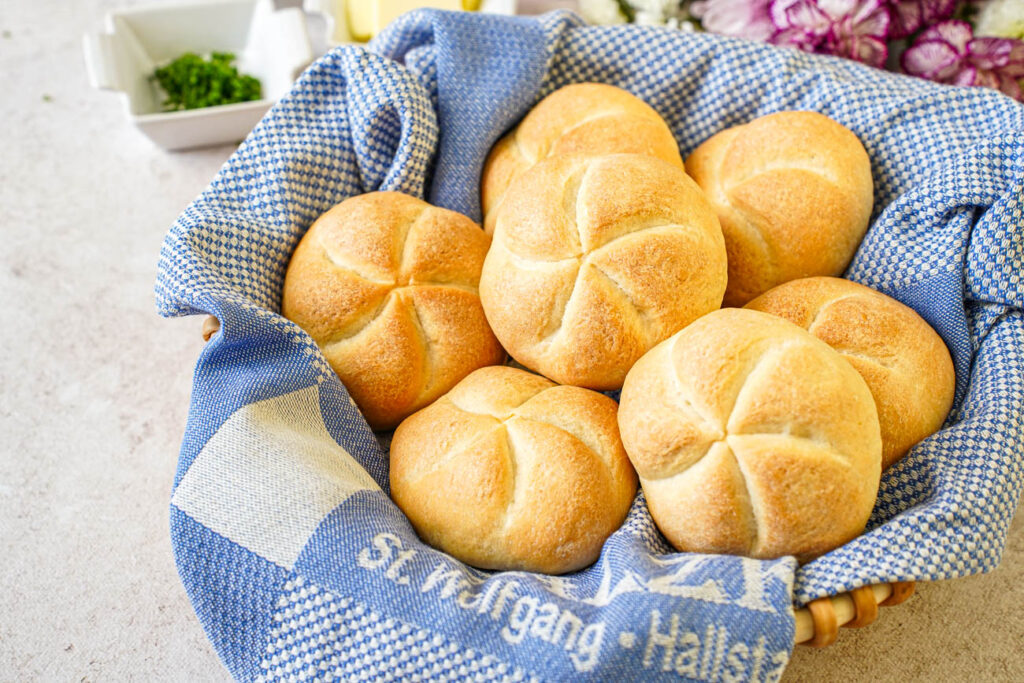
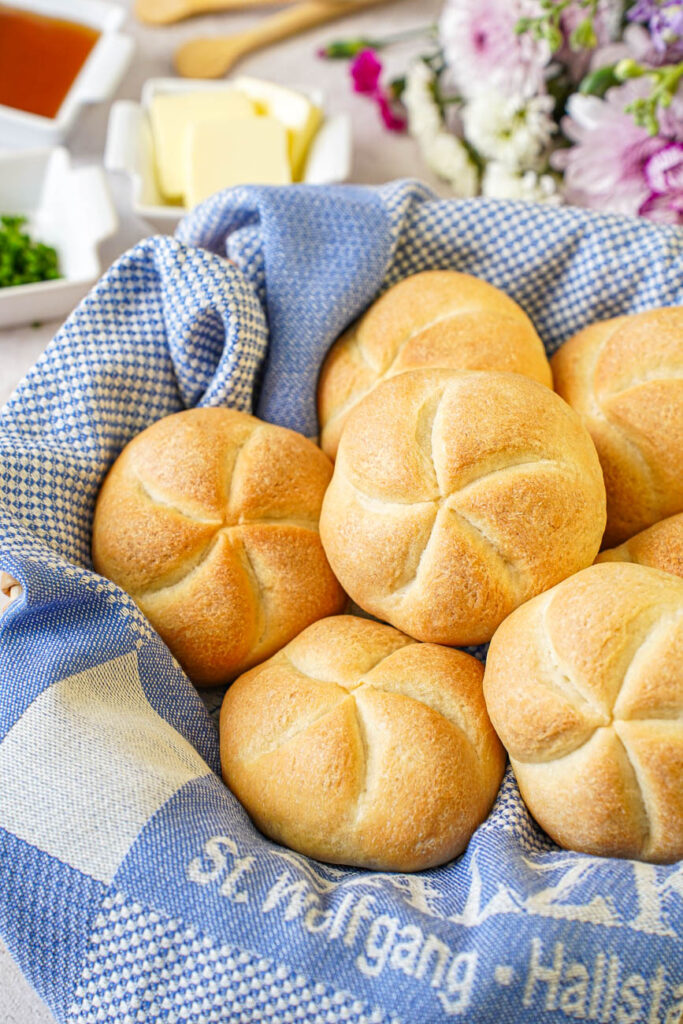
A recipe for Kaisersemmel (Kaiser Rolls) inspired by my time at the Wolfgangsee in Austria! These homemade rolls have thin, crispy crust with a soft, fluffy center.
Last fall, I visited Austria for the first time! I spent a little over a week traveling through Innsbruck, Salzburg, Wolfgangsee, and Linz, then finished with a few days in Germany to see friends before returning home. I completely fell in love with the country and miss everything already.
Today, I am covering my day trip to Wolfgangsee along with a recipe for Kaisersemmel (Kaiser Rolls).
Check out the rest of my trip:
- Kaspressknödel (Austrian Cheese Dumplings) and Innsbruck
- Schlutzkrapfen and Innsbruck
- Petersilienerdäpfel (Parsley Potatoes) and Salzburg
- Salzburger Nockerl and Salzburg
Wolfgangsee
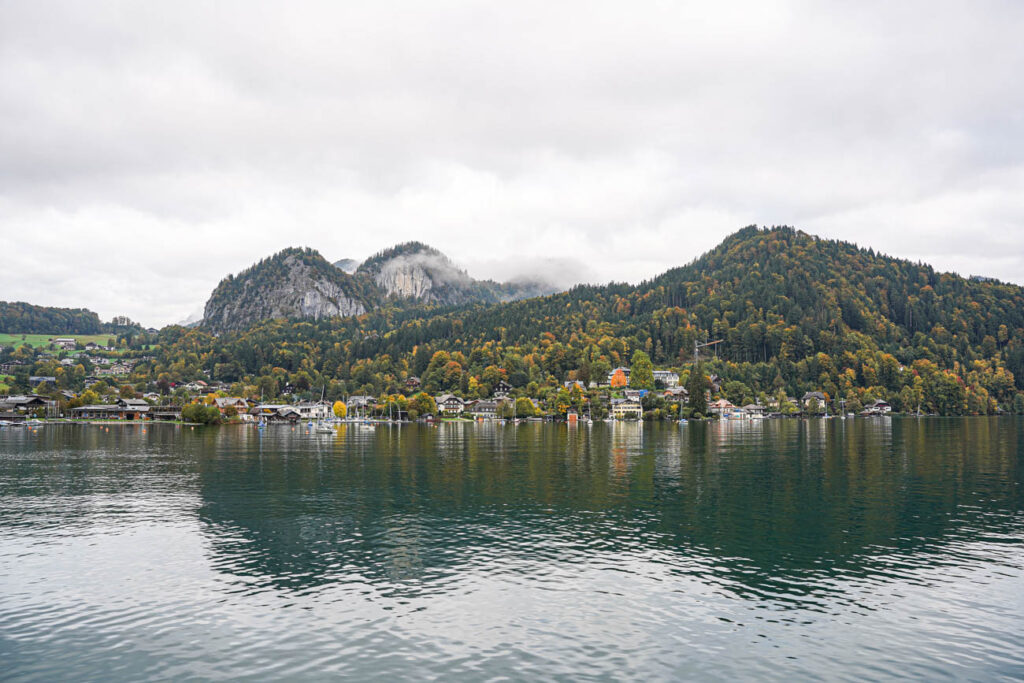
While staying in Salzburg, I decided on Wolfgangsee (Lake Wolfgang) as one of my day trips. It was such an incredible highlight during my time in the country.
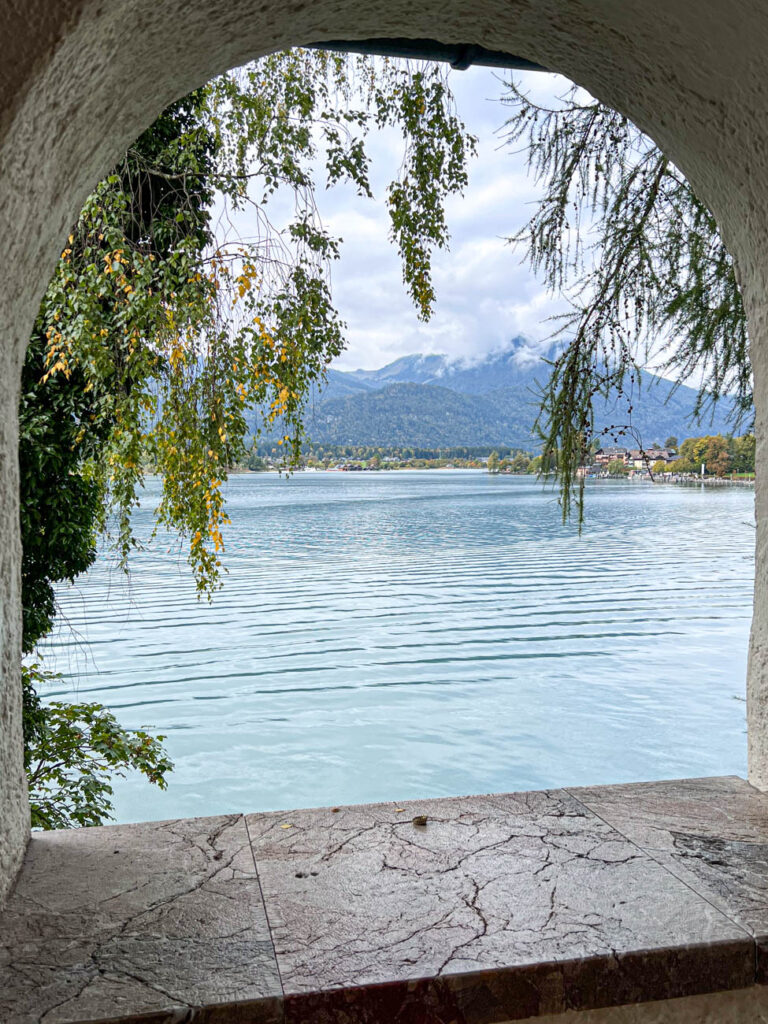
Wolfgangsee is a lake situated in the Salzkammergut region of Austria along the Bundesländer (states) of Salzburg and Oberösterreich. There are 76 lakes within the Salzkammergut and Wolfgangsee is particularly notable for its turquoise blue waters, charming towns, surrounding mountains, and the steepest cog railway in Austria.
The area is also popular for hiking, water sports, skiing, and other seasonal activities.
Within an 8 hour day, I had enough time to visit St. Gilgen, St. Wolfgang im Salzkammergut, and Schafberg. For a more relaxed pace, I recommend a couple of days or a long weekend to see more of the towns and surrounding region.
Try to stay as flexible as possible in your schedule if not visiting during a peak time (when tickets may sell out). I kept an eye on the weather during my five nights in Salzburg, booked nothing in advance (in October), and picked the day with the highest potential for sun to really enjoy the lake (of course I still ended up with mostly clouds, but at least it wasn’t raining).
Getting to Wolfgangsee
My stay at Hotel Goldgasse in Salzburg came with a Salzburg Verkehr Guest Mobility Ticket.
This covered unlimited public transportation within SalzburgerLand including Bus 150 that connects Salzburg to St. Gilgen on the western end of Wolfgangsee and Strobl on the southeastern end.
The bus starts at Südtiroler Platz in front of Salzburg Hauptbahnhof with multiple stops in the city before continuing east to Bad Ischl. If staying nearby, try to use the stop at the Hauptbahnhof since the bus will fill quickly during popular times.
It takes a little less than an hour to reach St. Gilgen Busbahnhof (and I was one of the few tourists stepping off here- almost everyone else was transferring in Bad Ischl to reach Hallstatt).
St. Gilgen
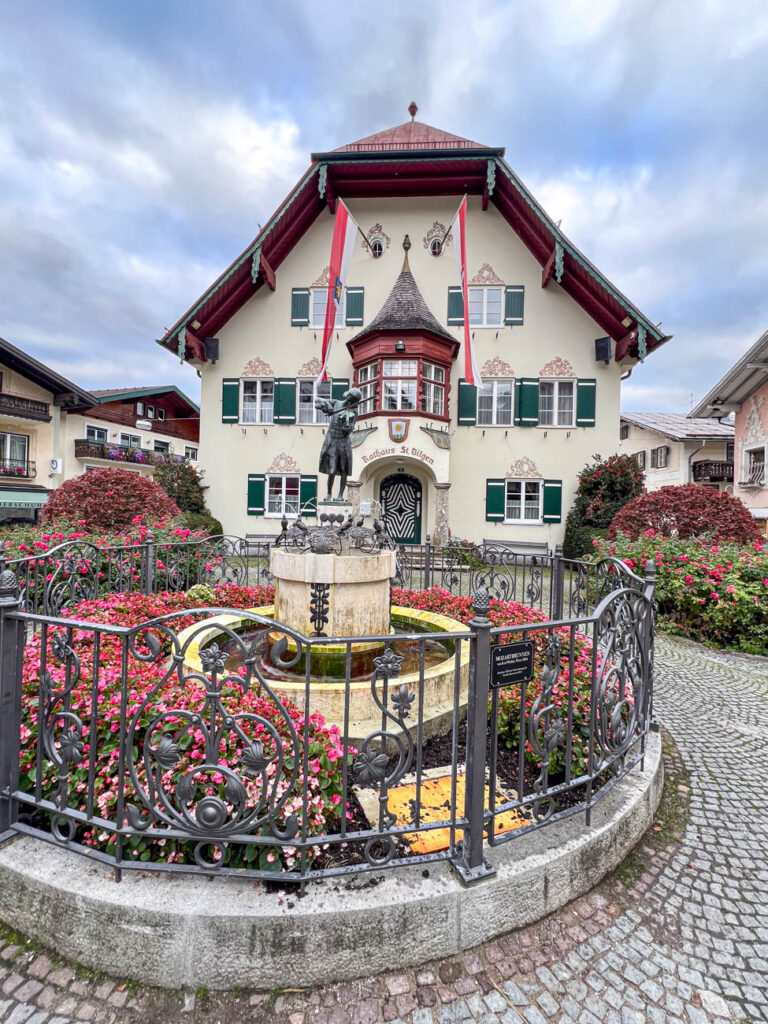
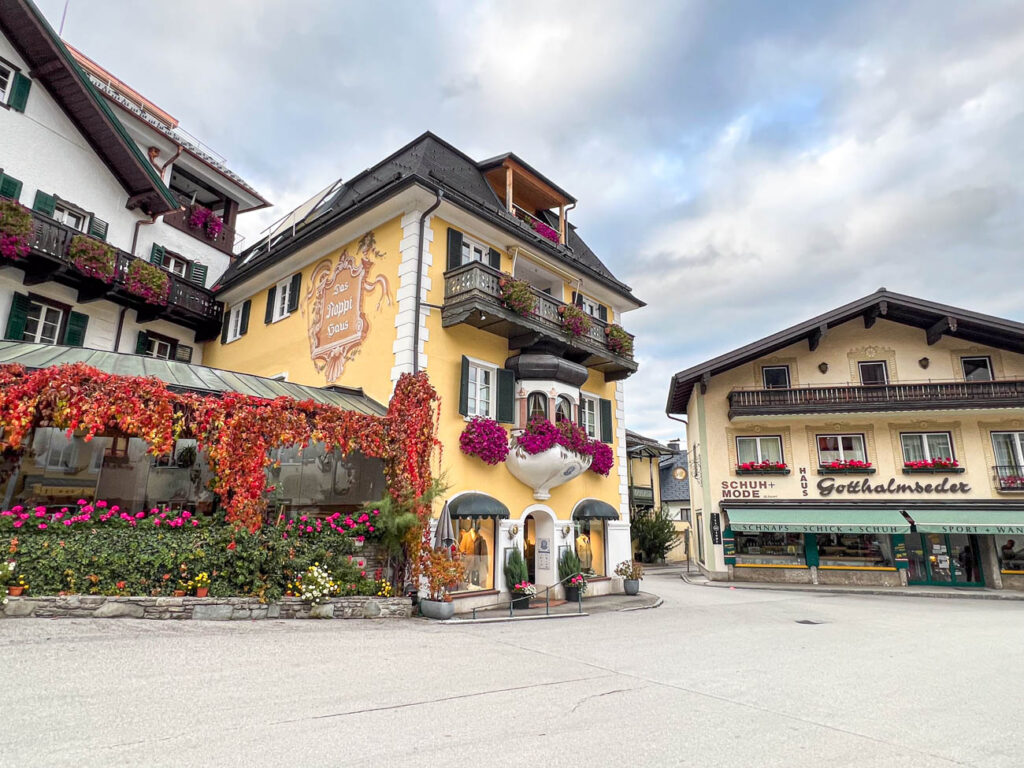
St. Gilgen is a picturesque town on the western end of Wolfgangsee with ornate baroque and rococo architecture, a lakeside promenade, cafés, restaurants, boutique hotels, and the Zwölferhorn Cable Car.
It was also the birthplace and home of Wolfgang Amadeus Mozart’s mother, Anna-Maria Pertl, and his sister, Maria Anna (Nannerl), lived here with her family.
Genuß Café
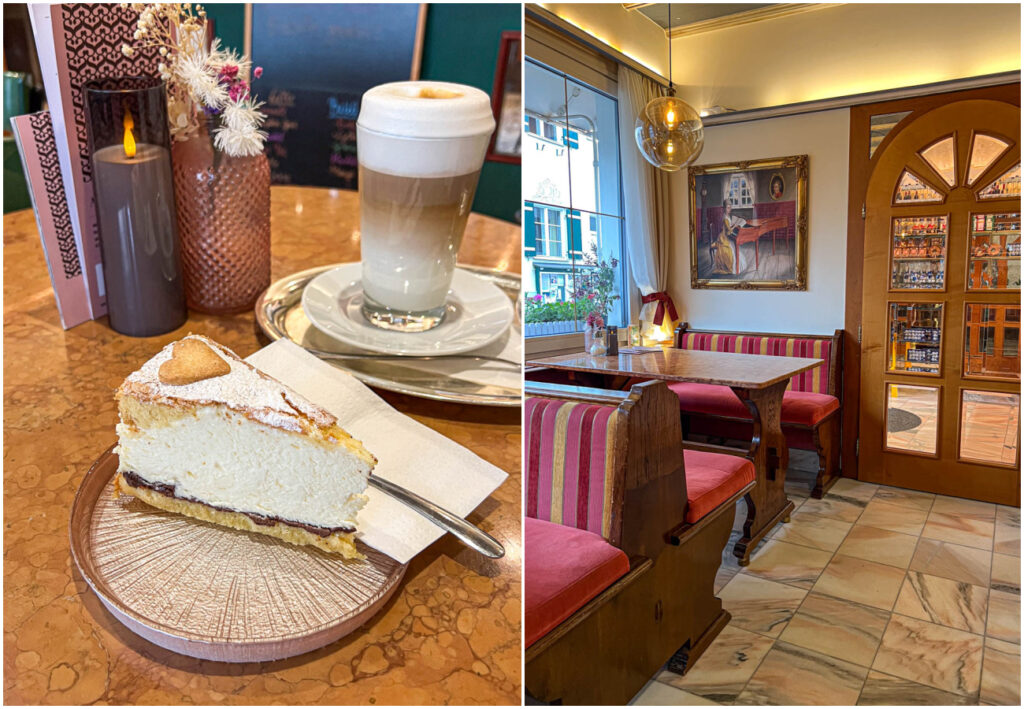
While in St. Gilgen, I stopped by Genuß Café at Mozartpl. 2a for coffee and cake.
This beautiful café features specialty coffee, other drinks, breakfast items, Strudel, cakes, small snacks, and ice cream with indoor seating or takeaway options.
I was immediately drawn to the Topfentorte (sponge cake with creamy Topfen filling- this version also had a layer of chocolate) and paired it with a Karamell-Latte (caramel latte- loved the layer of foam rising over the glass).
St. Wolfgang im Salzkammergut
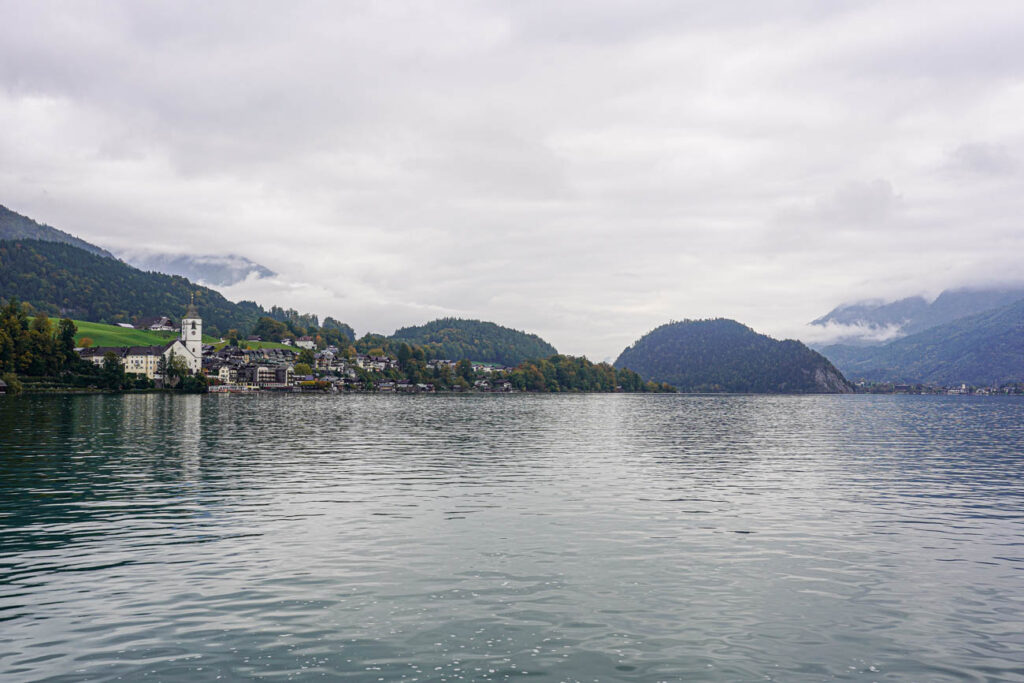
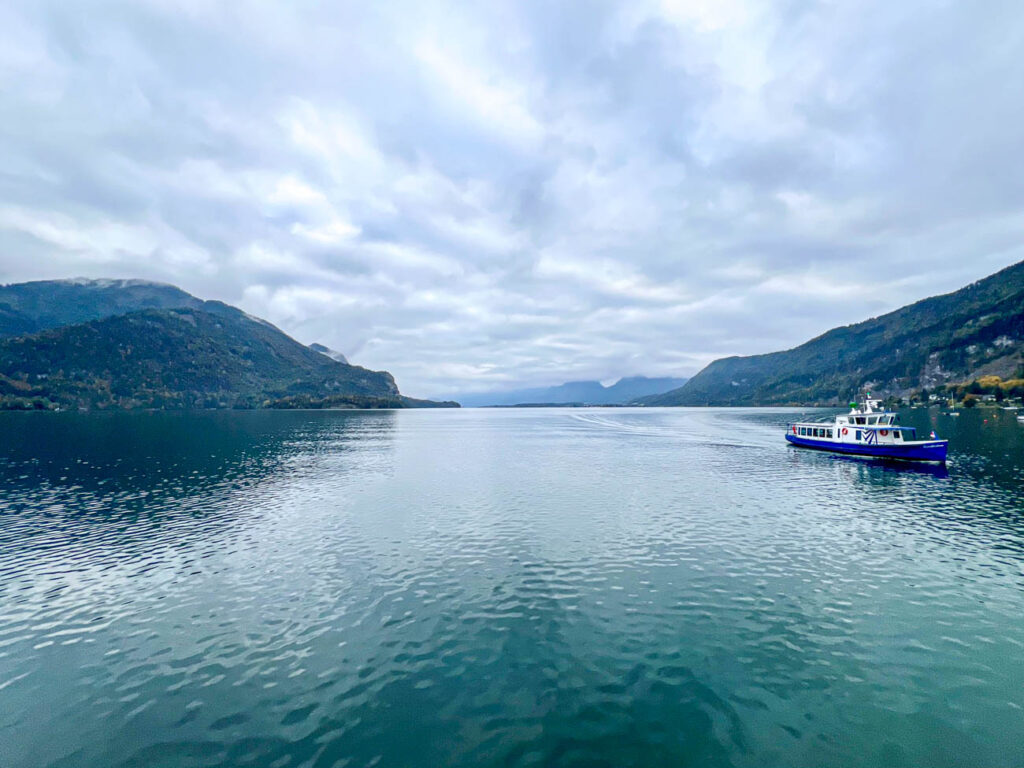
From St. Gilgen, I took the WolfgangseeSchifffahrt (local ferry) about 45 minutes to St. Wolfgang. There are multiple ticket options either online or at the ticket office and the exact schedule varies based on the season.
I went with the St. Gilgen nach St. Wolfgang hin und retour (roundtrip ticket from St. Gilgen to St. Wolfgang and back).
There are currently four modern ships operated by WolfgangseeSchifffahrt and the historic paddle steamer, RMS Kaiser Franz Josef I, which has been in service since 1873 (during the summer months, in good weather).
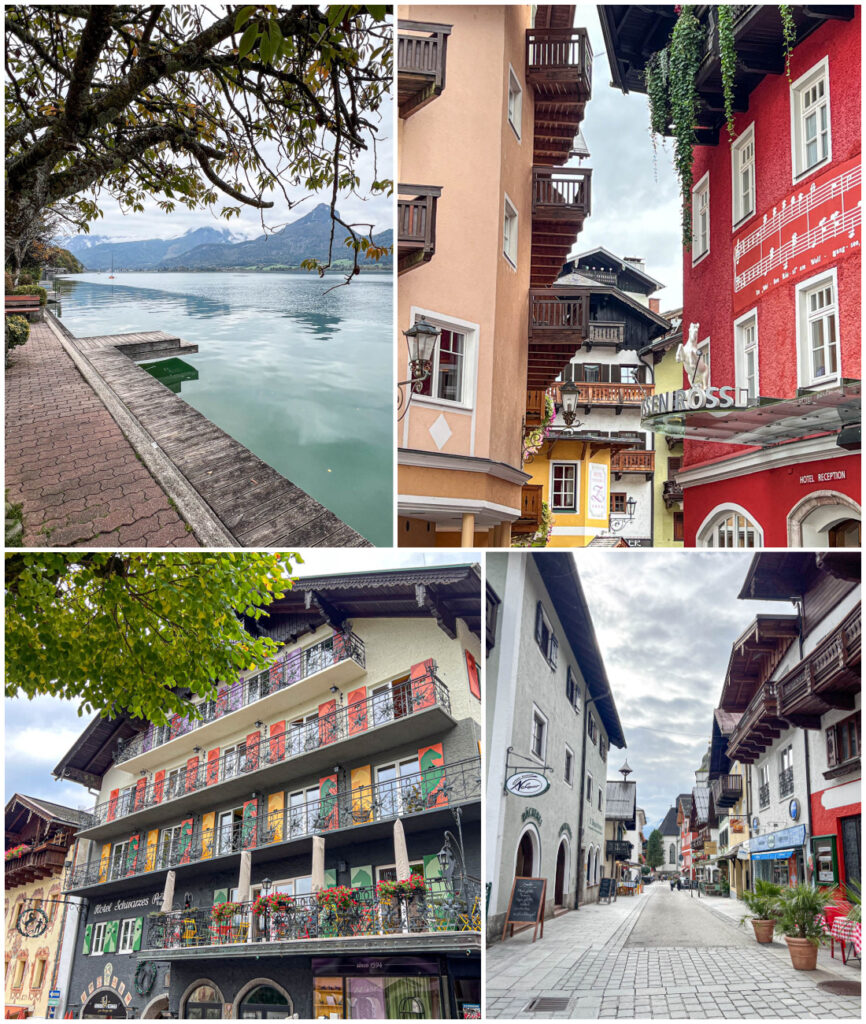
The St. Wolfgang Markt ferry stop is right in the heart of the town (if you are visiting Schafberg first, disembark at the St. Wolfgang SchafbergBahn stop).
Located on the northern side of Wolfgangsee in Upper Austria, St. Wolfgang im Salzkammergut is filled with small shops, gorgeous scenery, and restaurants highlighting local cuisine.
Notable sites include the Pilgrimage Church of St. Wolfgang, the Romantik Hotel Im Weissen Rössl (known as the setting for the 1930 operetta Im Weissen Rössl am Wolfgangsee/The White Horse Inn composed by Ralph Benatzky), and the SchafbergBahn.
Kaffeewerkstatt
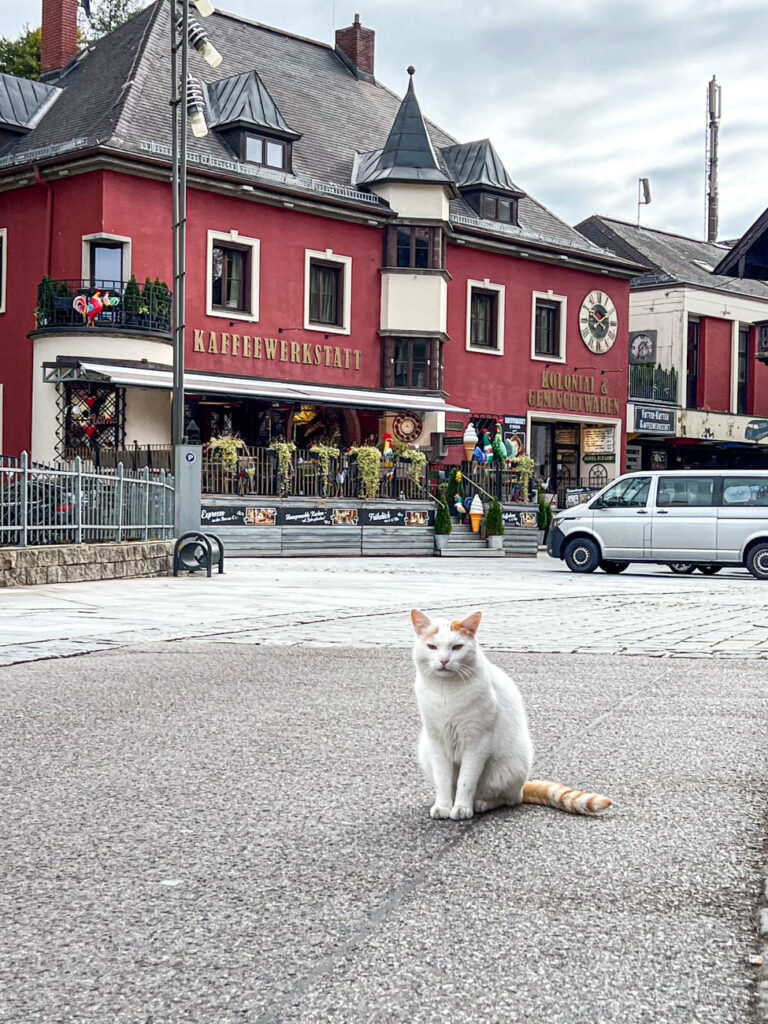
My first stop in St. Wolfgang was Kaffeewerkstatt at Markt 140. This cosy café has been located in the former post office building since 2011 and is currently open daily for breakfast, lunch, or take-out.
Along with a wonderful assortment of coffee, they also offer tea, regional specialties, breakfast classics, pastries, sausages, and small plates.
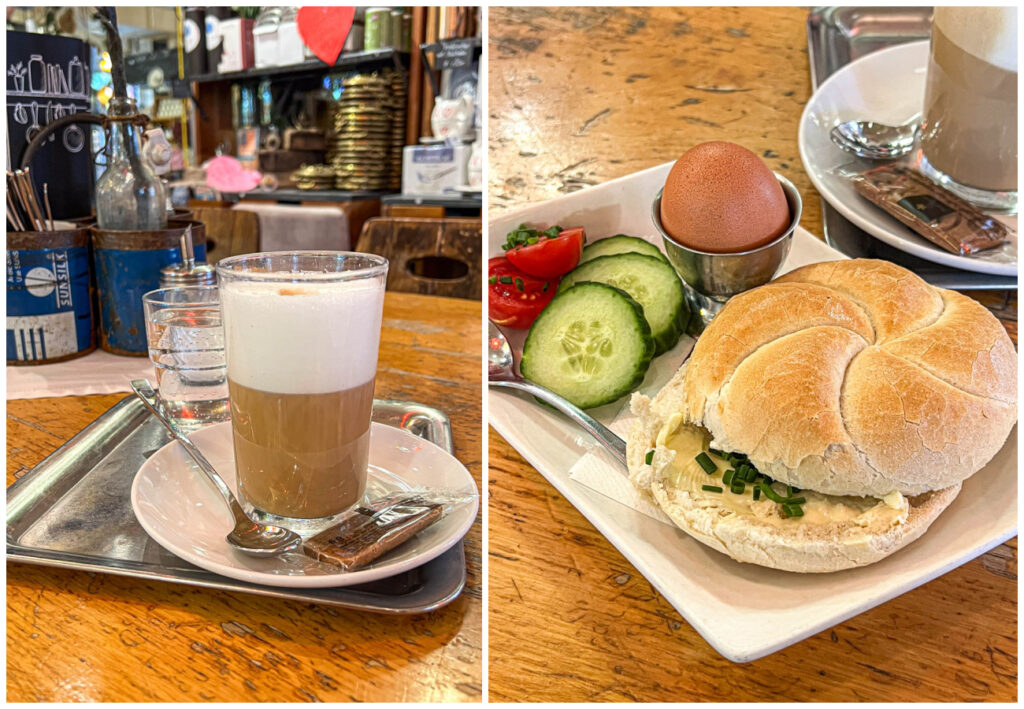
I ordered the Latte Macchiato and Bestrichenes Buttersemmerl – weiches Ei (buttered roll and soft boiled egg).
Benediktiner Seifenmanufaktur
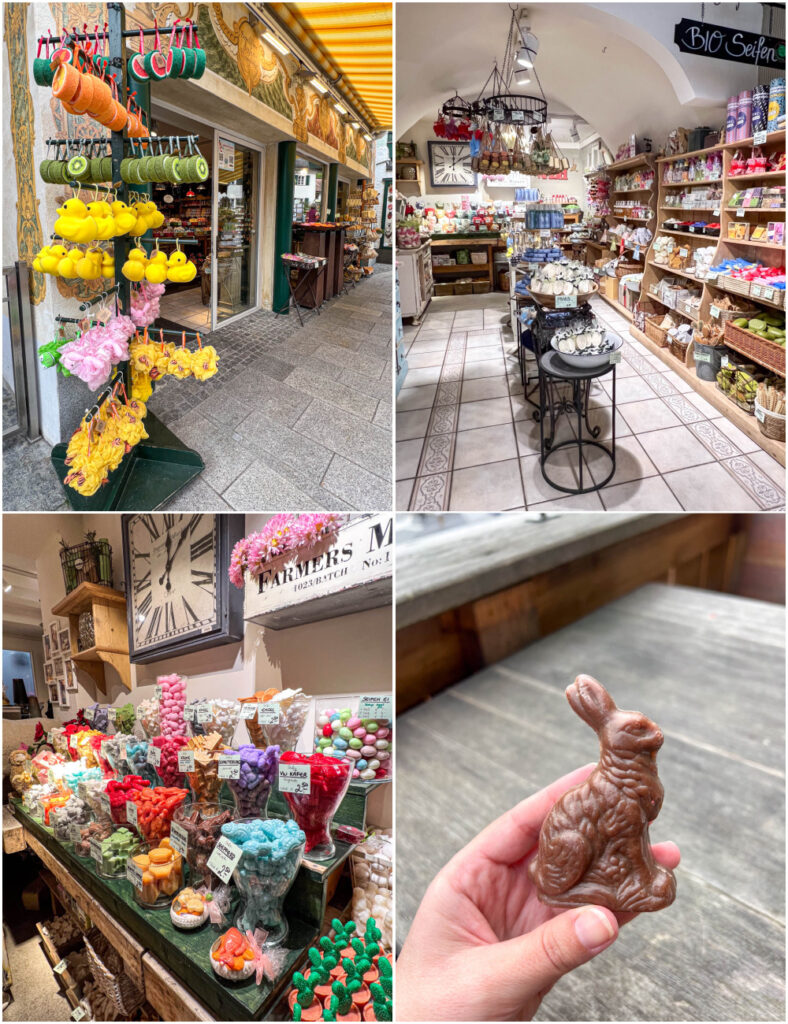
After breakfast, I walked along the street and came across so many fun shops. A particular favorite was Benediktiner Seifenmanufaktur at Markt 9.
This store is filled with a colorful, massive collection of soap in various colors, scents, and styles. The company has now expanded to Seefeld, Bad Ischl, and Hallstatt, but the products are still made in St. Wolfgang.
My kids were not fully amused by the bunny soap I brought back home (they very much thought it was chocolate at first).
St. Wolfganger Kräuterhaus
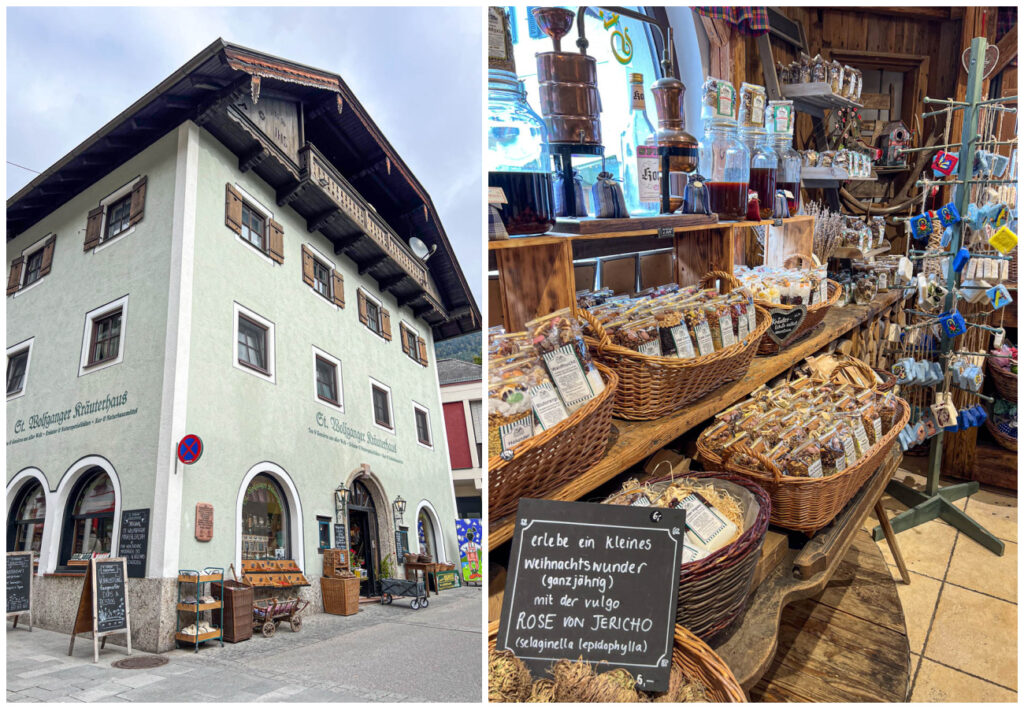
St. Wolfganger Kräuterhaus at Markt 26 has an assortment of regional Salzkammergut and more international dried herbs, tea (over 100 varieties), spice mixtures, curry blends, and more.
I picked up a package of Brotgewürz (bread spice) for my brother here.
Das Salzkontor
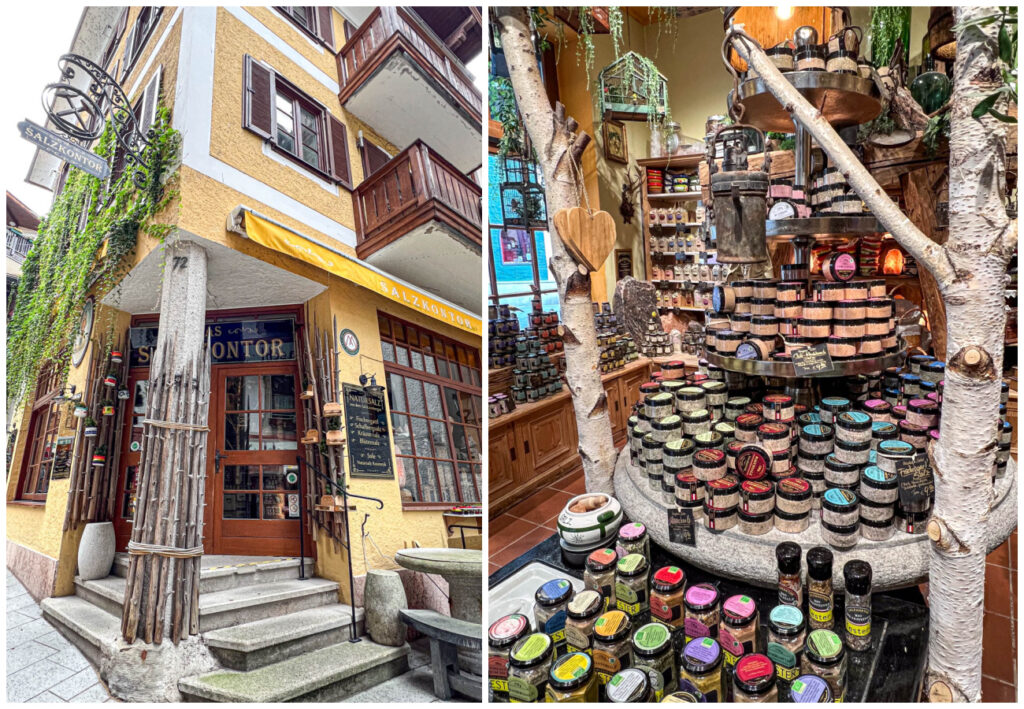
The Salzkammergut is home to the oldest salt mines in the world (Hallstatt- dating back 7,000 years) and Das Salzkontor highlights the local salt of this region with an assortment of natural salt, salt blends, and gifts.
Their original shop opened in Hallstatt in 2002 and they now have expanded to St. Wolfgang at Markt 72 and in Bad Ischl.
St. Wolfgang Kirche
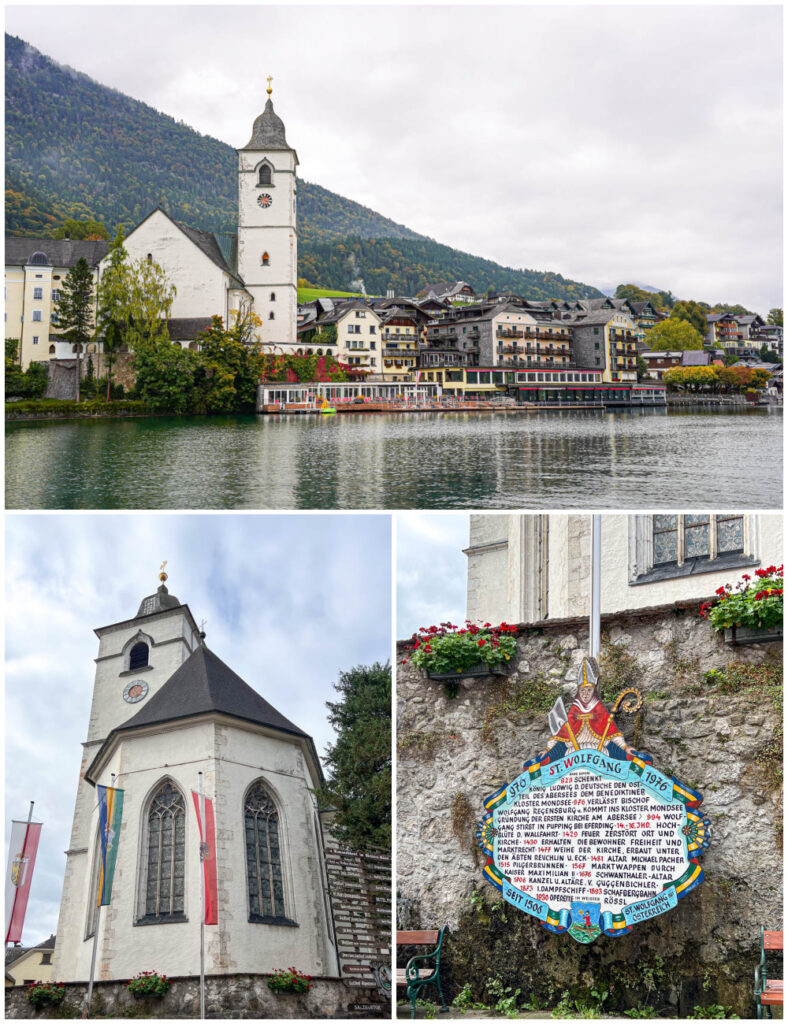
St. Wolfgang Kirche (Wallfahrtskirche St. Wolfgang, Pilgrimage Church of St. Wolfgang) at Markt 78 is a Catholic parish and pilgrimage church with a history dating back to the 12th century.
The current building is a 15th century Gothic church with a gilded, double-winged Pacher Altar created by Michael Pacher in 1481 and a Baroque double altar by Thomas Schwanthaler in 1676.
As a note, photography and filming are not allowed inside the church.
Schafberg
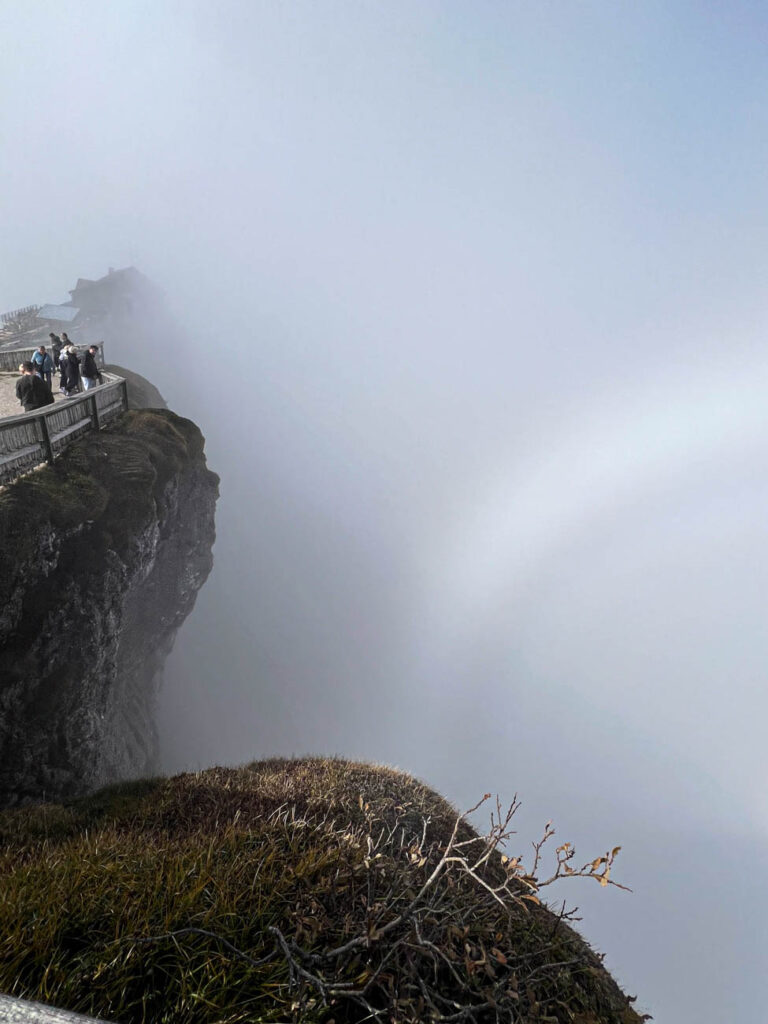
Schafberg is a 1,783 meter (5,850 ft) mountain north of St. Wolfgang along the border of Salzburg and Oberösterreich in the Austrian Alps.
I wasn’t sure if I was going up or not since the weather still wasn’t the best during my short visit. I decided to go ahead and attempt once the sun started to peek out in the afternoon.
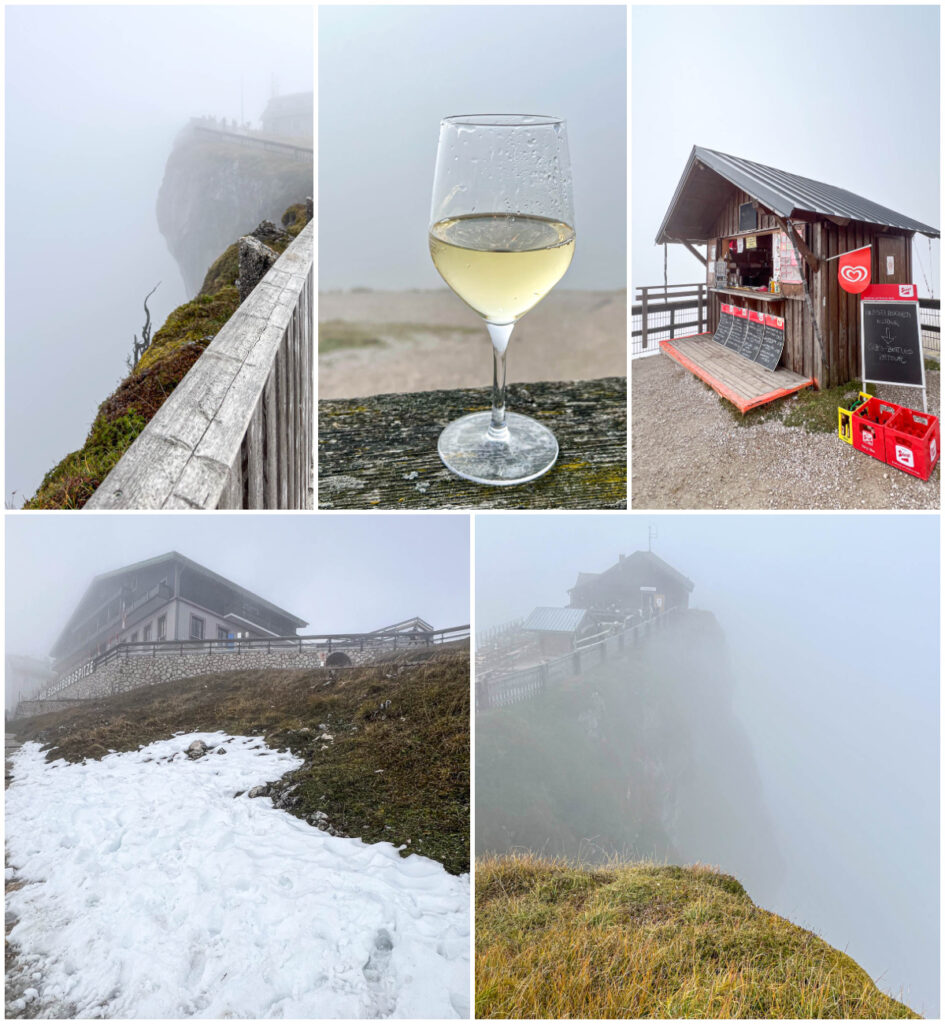
While the sun was shining along parts of the lake, the clouds unfortunately persisted on the mountain. I still don’t regret it. The experience of taking the SchafbergBahn was fun regardless and peering over the cliffs and seeing nothing but fog was very memorable (if not slightly eerie).
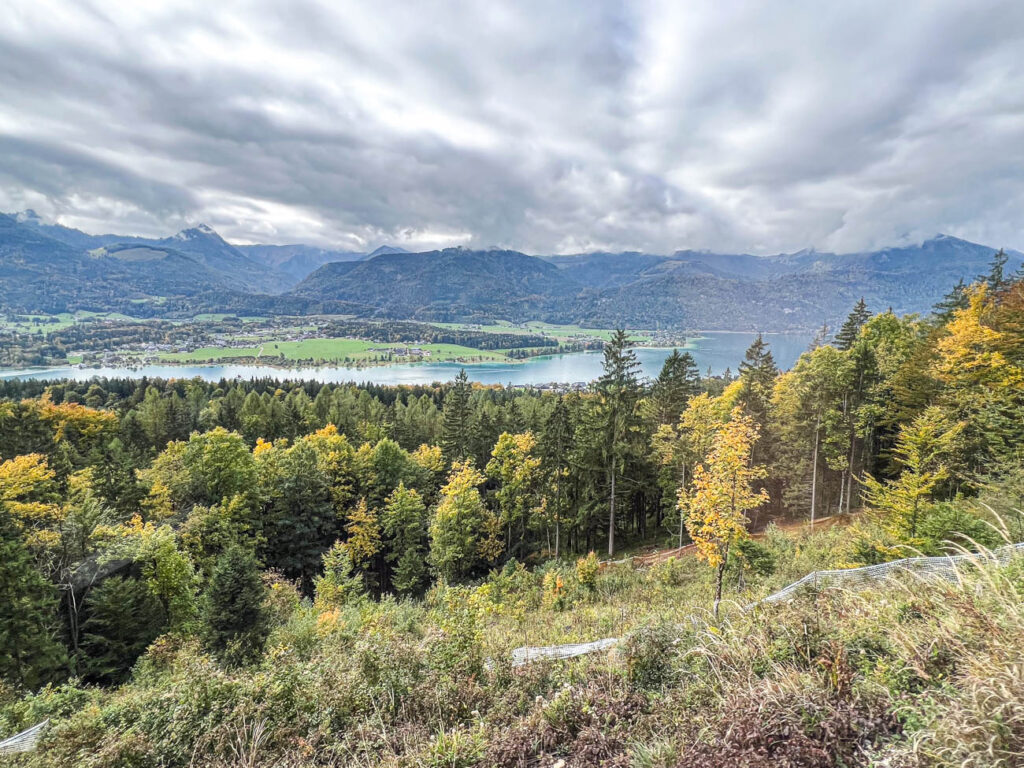
If you get a bit more lucky, the summit offers a panoramic view of the region with the surrounding towns and up to 13 lakes in the distance.
Other than taking in the views, the mountain is also home to Hotel Schafbergspitze (Austria’s oldest mountain hotel with the Berghotel restaurant on the ground level) and the Himmelspforte (a cliffside Alpine hut with hearty local meals, smaller snacks, and drinks).
SchafbergBahn
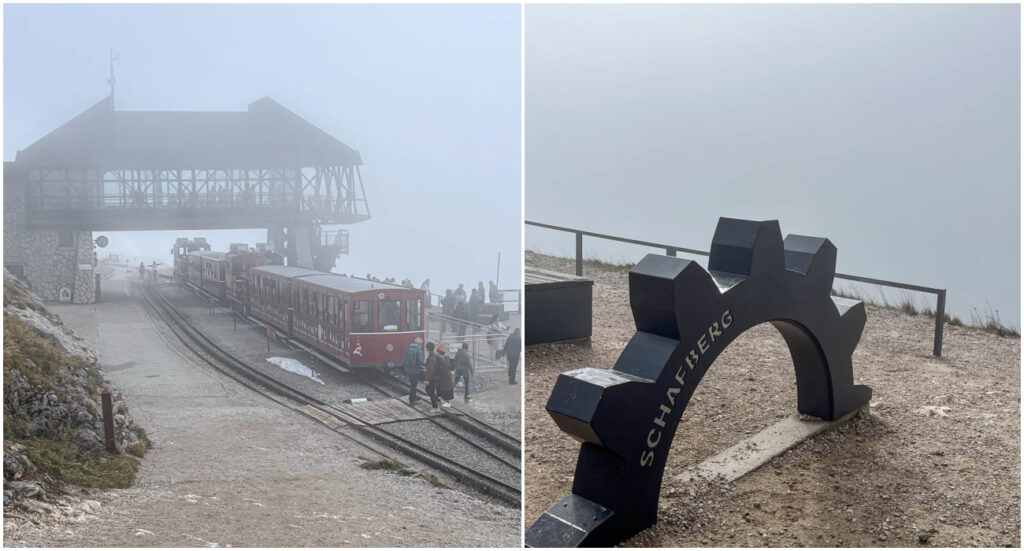
The quickest way to reach Schafberg is via the SchafbergBahn- the steepest cog railway in Austria. It has been in operation since 1893.
From the valley station in St. Wolfgang, the steam-powered train travels 5.85 kilometers (3.6 miles) and 1,190 vertical meters (3,904 ft) to the top station 50 meters (164 feet) from the summit in about 35 minutes.
I did not personally get it since I didn’t decide until the last minute whether I was going to Schafberg, but there is a combo ticket which covers the WolfgangseeTicket (allows one to board and disembark one time at each of the seven stops around the lake) and a roundtrip on the SchafbergBahn.
During busy times, tickets for the railway may sell out.

Want a more adventurous option? Hiking trails are available to travel by foot up the mountain. Depending on your pace, this should take around 4 hours. You can also mix it up by hiking up and taking the rail for the return.
Dorf-Alm zu St. Wolfgang
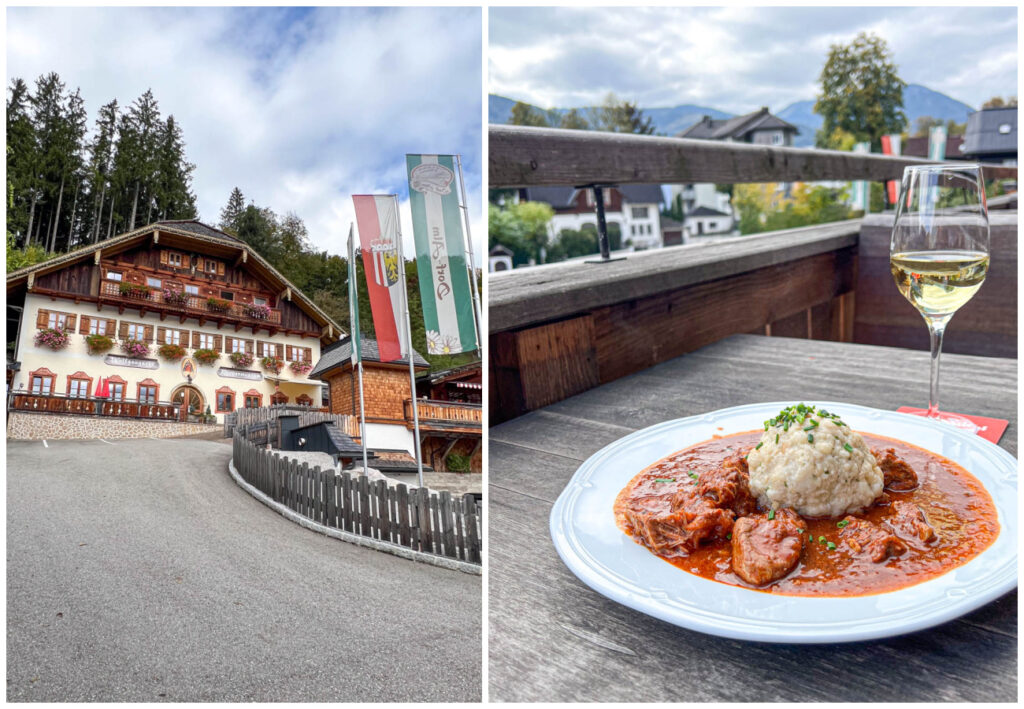
About 500 meters (1/3 mile) to the east of the SchafbergBahn entrance is Dorf-Alm zu St. Wolfgang.
This traditional restaurant features regional Austrian cuisine in an Alpine hut setting with indoor and outdoor terrace seating. The menu has an assortment of soups, light meals, salads, pasta, desserts, and local classics.
I enjoyed a comforting plate of Rindsgulasch vom heimischen Rind und Semmelknödel (Beef Gulasch with a bread dumpling) and a glass of the Hauswein (Grüner Veltliner | Weingut Minkowitsch | Niederösterreich).
It was the perfect end to my day before heading back to Salzburg.
Kaisersemmel
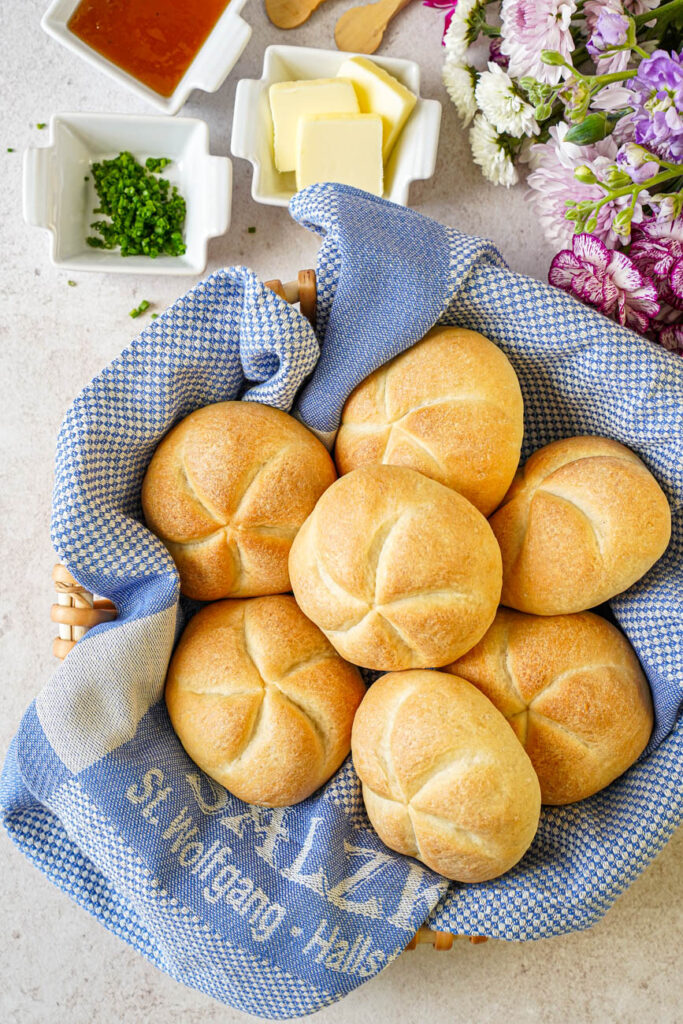
After coming back home, I especially missed the Kaisersemmeln. These round, wheat-based rolls are perfect as a part of a breakfast spread, alongside sausages, as the base for sandwiches, or paired with larger meals.
In our area of the US, I can usually find Kaiser Rolls at the grocery stores, but they are not quite the same here. The texture is softer and more similar to a hamburger bun compared to the crisp, crackling crust of the rolls in Austria.
Since October, I have been working on trying to recreate that notable texture and this is the closest I’ve gotten so far using my conventional oven.
Forming the Kaisersemmeln by Hand
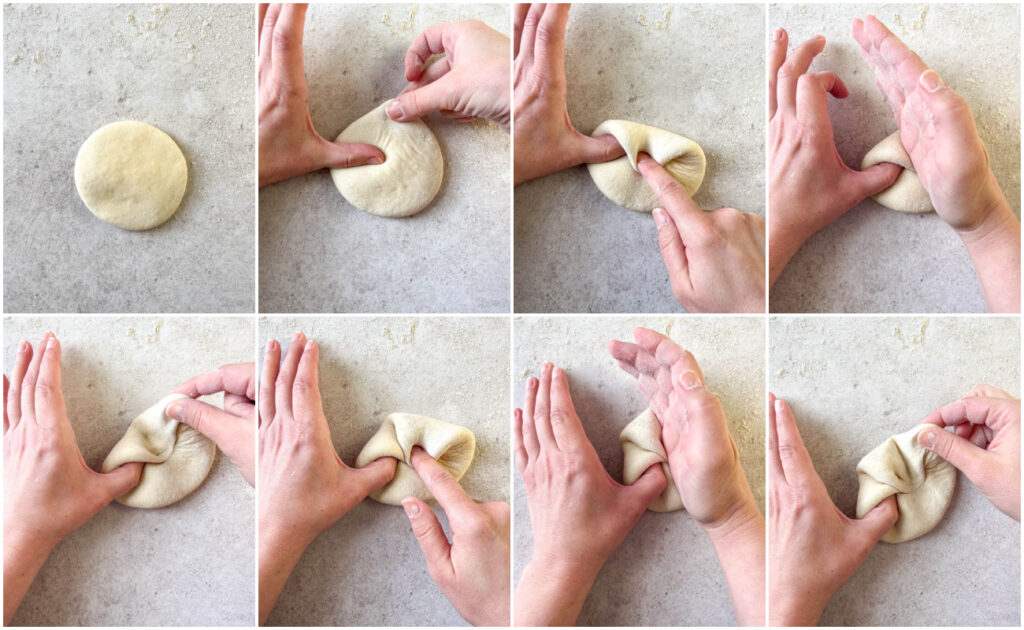
There are two different ways to get the pronounced star shape on top of the rolls- either stretching or forming by hand or with a star press.
The easiest is with the press, but the traditional shaping is definitely more fun once you get the hang of it (I still need practice). Der Backprofi has a video with a close up on how to form each Kaisersemmel by hand.
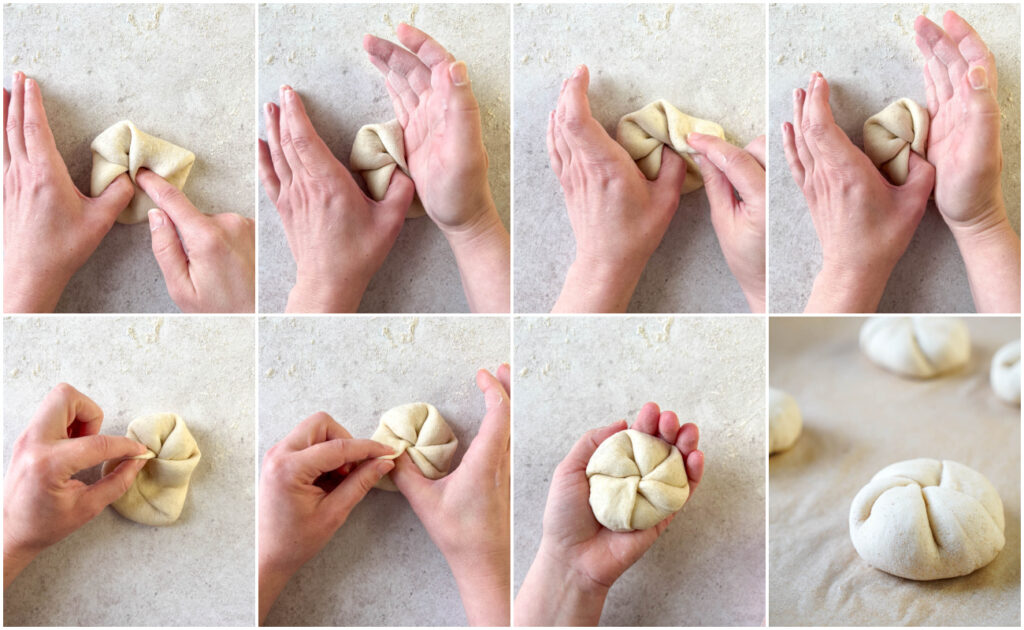
Start by lightly dusting each side of the ball of dough with rye flour. Press down gently with your palm to form a disc.
Place the thumb of your non-dominant hand (I am right handed so I used my left hand) in the center of the disc with the tip of the thumb resting near the middle.
With your other hand (leave your thumb where it is) grab the top of the circle and pull it down just over the thumb, pressing lightly to seal. Use the side of your hand (slightly curved) to press down next to your thumb to make the first swirl.
Repeat this process three more times (keeping your thumb where it is) to make four swirls around the roll.
For the final section, remove your thumb and tuck the remaining dough in the little cave created by your thumb. Gently press around the edges of the roll to create a smooth circle with five swirls across the top.
If the dough keeps shrinking as you try to form it, cover and allow to rest for a few more minutes at room temperature before trying again.
Make sure to place the formed rolls swirl side down on the prepared baking sheets for the final rise. This will help them hold their shape.
Forming the Kaisersemmeln with a Stamp
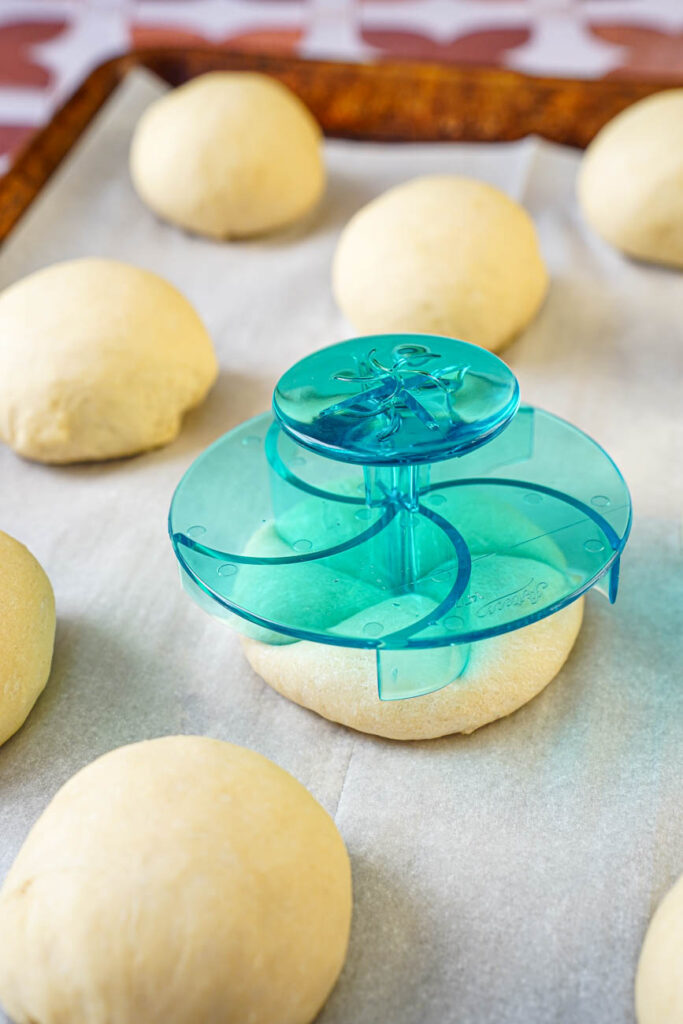
To use the press/stamp, simply push down to shape. It should be deep enough to hold the shape during the final rise, but take care to not cut through the dough.
A Few Kaisersemmel Tips
If you have access to European flour, use Weizenmehl Type 550 or Austrian Weizenmehl Type 700. Do not pack in the flour when measuring or you may end up with too much. To measure flour, gently spoon it into the measuring cup and level with a knife without pressing down. The most accurate way to measure is by weight.
When adding the yeast to the water, make sure the water isn’t too hot or it will damage the yeast. The temperature should be about 105˚F (40˚C)- just warm enough to activate the yeast.
If the dough is too crumbly and just won’t come together, add some more water a splash at a time. Add just enough flour to create a smooth and workable dough. Too much flour or overworking will cause the bread to become dense.
These rolls can easily be made the same day/morning with about 2 hours total in rise time. You can also prep the dough the night before, cover and refrigerate overnight, then bring to room temperature for an hour before shaping and forming.
When baking, lightly brush or spray the rolls with water. It shouldn’t be so much that the water pools in the swirls.
Kaisersemmel Serving Ideas
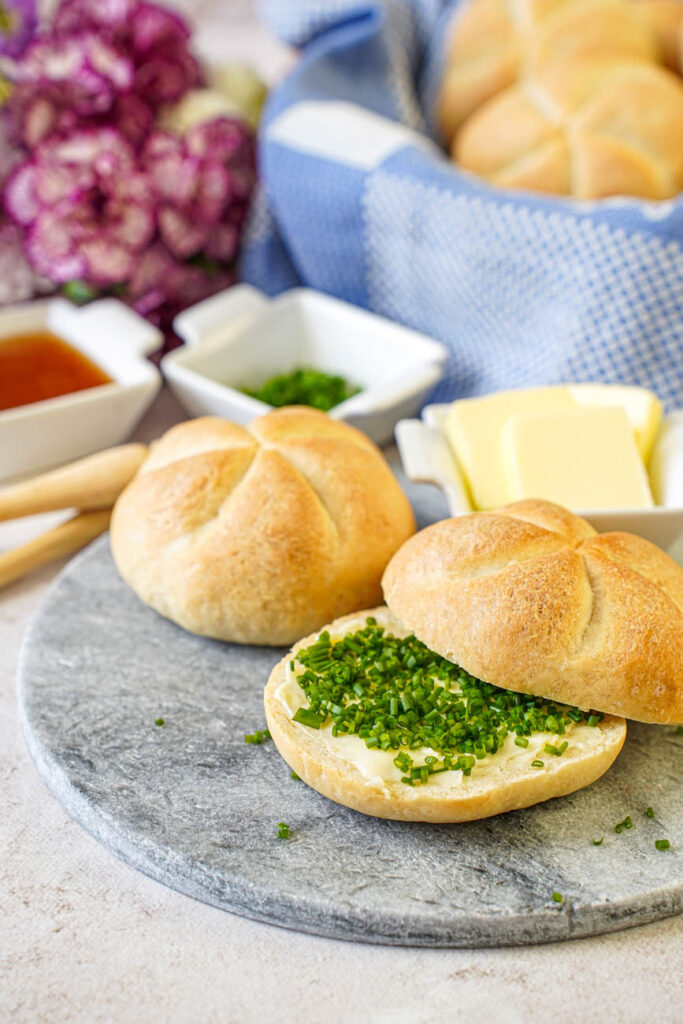
My absolute favorite way to enjoy a Kaisersemmel is while still warm from the oven with a layer of butter and thinly sliced chives.
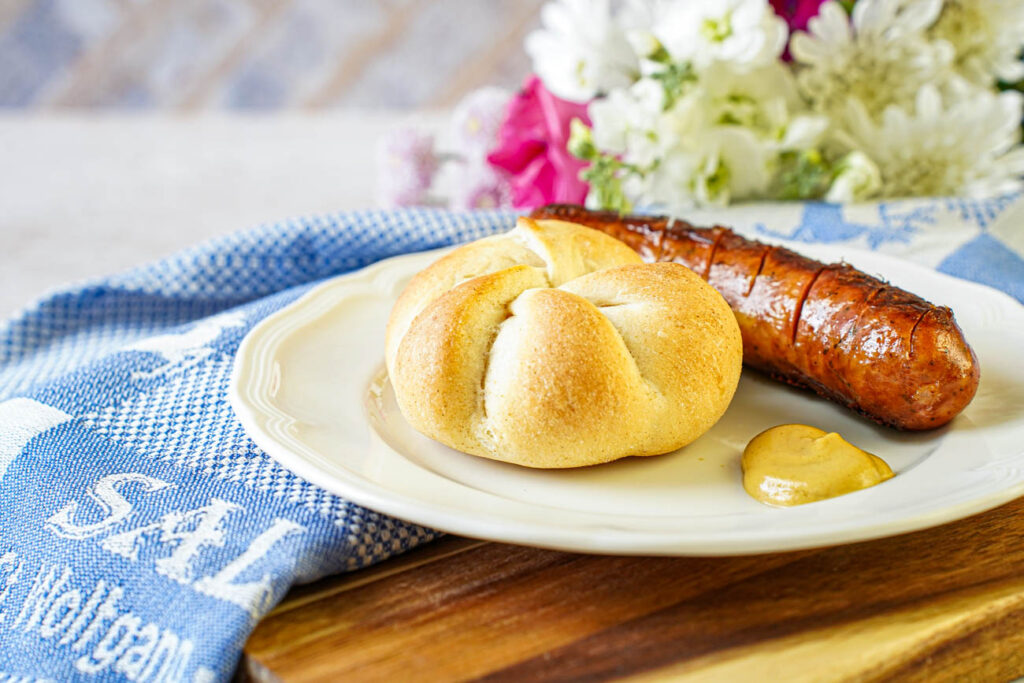
They are also delicious paired with grilled sausages such as Käsekrainer. Other options include jam, honey, or as sandwiches.
Once a couple of days old, I usually cut the leftovers into small cubes and use them as the base for Semmelknödel (bread dumplings) such as Kaspressknödel and Speckknödel.
Kaisersemmel (Kaiser Rolls) Recipe
Adapted from Red Currant Bakery
Kaisersemmel (Kaiser Rolls)
Ingredients
- 2 1/4 teaspoons (7 grams) active dry yeast
- 3/4 cup (180 milliliters) lukewarm water 105-115˚F (40-46˚C)
- 3 1/2 cups (440 grams) all-purpose flour Weizenmehl Type 550 or 700
- 1 teaspoon fine salt
- 1/2 cup (120 milliliters) lukewarm milk 105-115˚F (40-46˚C)
- 1 tablespoon (15 milliliters) honey
- 3 tablespoons (42 grams) unsalted butter softened at room temperature
- rye flour for dusting
Instructions
- In a small bowl, sprinkle the yeast over the lukewarm water. Stir briefly and allow to sit at room temperature until frothy, about 10 minutes.
- In the bowl of a stand mixer fitted with a dough hook or a large bowl, combine the flour and salt.
- Mix in the water with the frothy yeast, milk, honey, and butter until a smooth dough forms.
- Knead on a lightly floured surface until soft and elastic. If too stiff and crumbly, mix in a little more water. If too wet and sticky to handle, lightly add a little more flour.
- Place the dough in a large bowl, cover, and allow to rest at room temperature until doubled, 1-2 hours.
- Divide the dough into smaller portions about 75-80 grams (2.6-2.8 ounces) in size. There should be 9 to 10 in all.
- Form each portion into a smooth ball and place on a work surface lightly dusted with rye flour. Cover and allow to rest at room temperature until puffed, about 30 minutes.
- Line two rimmed baking sheets with parchment paper.
- Once puffed, the star shape can either be formed with a stamp/press or by hand.
- If using a stamp, lightly dust each side of the round with rye flour, press down in the center of the round with the stamp without cutting through the dough, then place the round, stamped-side down, on the prepared baking sheet. Repeat with remaining rounds, arranging them 2 inches (5 centimeters) apart.
- To shape by hand, lightly dust each side of the round with rye flour. Press down gently with your palm to form a disc.
- Place the thumb of your non-dominant hand (I am right handed so I used my left hand) in the center of the disc with the tip of the thumb resting near the middle.
- With your other hand (leave your thumb where it is) grab the top of the circle and pull it down just over the thumb, pressing lightly to seal. Use the side of your hand (slightly curved) to press down next to your thumb to make the first swirl.
- Repeat this process three more times (keeping your thumb where it is) to make four swirls around the roll.
- For the final section, remove your thumb and tuck the remaining dough in the little cave created by your thumb. Gently press around the edges of the roll to create a smooth circle with five swirls across the top.
- Place the formed rolls, swirl side down, on the prepared baking sheets about 2 inches (5 centimeters) apart. Cover the baking sheets and set aside for 20 minutes, until lightly puffed.
- Preheat the oven to 450˚F (230˚C) with one rack in the center and another rack towards the bottom.
- Place a pan of water on the bottom rack.
- Once ready to bake, flip the rolls over so the swirl design is on top.
- Lightly brush or spray the rolls with water and place in the preheated oven. Immediately reduce the temperature to 425˚F (220˚C) and bake for 5 minutes.
- Open the door for 10 seconds to release steam and continue cooking for another 5 minutes.
- Remove the baking sheet from the oven, lightly spray or brush the rolls with more water, and continue to bake until golden brown across the top, 5-8 minutes.
- Transfer to a wire rack and allow to cool for about 10 minutes before serving.
Leave a Reply